Thursday, 24 July 2008

Libraries need protection from lap dancing clubs

Libraries are under threat from lap-dancing clubs. According to Theresa May, "local people often have legitimate reasons for objecting to the planned location of a lap-dancing club - if it is near a school or a library for instance."

Sometimes politicians just pick on the weirdest things.

Tuesday, 22 July 2008

Edinburgh Dungeon breaches anti-discrimination laws?

News that Edinburgh Dungeon is refusing access to English people, unless they sign an oath of allegiance to Scotland, raises questions about whether the museum is breaching European anti-discrimination laws.

According to the Telegraph: The Edinburgh Dungeon said the one-day event is in revenge for the Battle of Falkirk, fought 710 years ago July 21st, at which more than 2,000 Scots were slaughtered by the Auld Enemy. English visitors will only be allowed entry if they sign a scroll swearing allegiance to Scotland, while those from other countries will be encouraged to bring in items deemed 'typically English’ to be smashed.

So not only are they being deliberately offensive to people who had nothing to do with a battle 700 years ago, they are simply destoying 'English' items for the sake of it. In an age of when we are all encouraged to recycle and minimise our use of natural resources and minimise our waste output, this can only be seen as grossly irresponsible. Not fun, just wasteful.

What would have happened if they had said that black people weren't allowed into the museum unless they swore an oath of allegiance to white people?

Obviously it is a one day event, and this whole thing is just a publicity stunt. However, such xenophobic nonsense is hardly condusive to better relations.

Update:
According to the Campaign for an English Parliament site, the Commission for Racial Equality has made a complaint and the police have also been involved.

Update 2:
Looks like there were lot of complaints!

"Changing our Drinking Culture" - social engineering out of control

The Guardian has reported that 'Ministers' plans for tackling the problem were unveiled today in a new alcohol strategy entitled, Changing our Drinking Culture'. Isn't this the same Government that introduced 24 hour drinking licences?

The plans involve "limits on 'happy hours' in bars and clubs and the possible introduction of cigarette-style health warnings on bottles and cans" and "assessing whether pub landlords should be obliged to offer smaller servings". Aside from the fact that these are the least imaginative and least effective solutions possible, why is the Government intervening at all?

The role of Government should be to protect and serve the people. The damned socialists are at it again, dictating how other people should lead their lives. In a free society people should be allowed to get drunk. There is NOTHING wrong with alcohol 'abuse' as long as it doesn't negatively impact on other people. In fact, it is part of British culture, if such a thing exists.

Does it mean that a substantial amount of NHS services are required to deal with accidental alcohol related injuries? Yes. But that is what those drinkers pay their taxes for.

If the Government really wanted to reduce alcohol consumption, they should cut benefits payments. I haven't met a single person on benefits yet who can't afford to go boozing and/or smoking.

Government plans e-petitions to waste your time and money

The Government has announced plans to use e-petitions to allow the public to raise issues with Parliament. "Ministers would be expected to reply to most of them, while some would be picked for debate by MPs in Westminster Hall or for select committee scrutiny. "

But haven't we heard all of this before? What is the 10 Downing Street petition website all about then, if it isn't for the public to submit petitions? Why would a Government announce a second petition system that offers nothing that the first one can't provide? If they want petition-based ideas to discuss in Westminster, then look at the existing site, instead of wasting yet more tax money on making a new one.

Is this because they don't have enough to do and need to fill up their time? As Brussels takes over more and more control of our Government at one end, and councils/assemblies/quangos gain more power at the local level, there is less and less for our MPs to do. Perhaps discussing ideas sent in by the public (sounds just like Big Brother's Big Mouth, doesn't it?) is all they can think of to fill up their time.

There are, as mentioned, thousands of petitions already, but what has the Labour Government done with these? Nothing. Why should anyone bother to use yet another petition system when the first one has been ignored? Isn't this really just another way to allow people to vent without Government having to take any notice?

Promoting petitions can take many hours and considerable amounts of money. But what can we expect in return for our efforts? Not a lot. "Ministers would be expected to reply to most of them" - not all, most. So we don't even have a guarantee that it won't be completely ignored, and even then, most will simply receive a 'reply'.

There doesn't even seem to be a system in place to force MPs to debate or act on the most popular petitions; some might get 'picked' (presumably if they are politically advantageous), but there are no criteria to meet.

We should also ask the question - if there are issues that need to be discussed in Select Committees and Parliament, why aren't they being discussed already? What on Earth are we paying our MPs for? Are they so out of touch with the public that they don't already know what concerns their constituents? Any MP admitting to that state of affairs should quit immediately and let someone else do the job.

Has Trevor Phillips drowned under his own politically correct guff?

"The Equality and Human Rights Commission must be given the power to fight the class divide in Britain, its chairman has said" the BBC reports, leaving all sane people with an uneasy feeling in their stomachs. Unfortunately, the BBC forgot to tell us what these desired powers might consist of. Luckily his communist sounding rhetoric is backed up on the Commission's website.

The article brings out that tired old argument of 'The divide between rich and poor has widened to its highest level for 40 years', which sounds awful, but in actual fact means absolutely nothing. It doesn't mean that poor people are poorer, it just means that the rich are richer. It also claims that a survey 'found that 76 per cent of people considered the gap between rich and poor to be too large'. I wonder which 76 percent said that? Hmm.

This is of course typical ugly socialism; the politics of jealousy. Don't congratulate people for doing well and making money, oh no, socialists want to take it off them and give it to people unable to make it for themselves. There is no such thing as a fair redistribution of wealth - it is just extortion under threat of imprisonment. It is one thing to tax people to provide services, it is a completely different thing to tax them simply to give their money to other people. Anyway, I digress.

Oddly, Philips seems to forget that he has made a major case against financial 'inequality' and instead manages to come up with a solution to a completely different problem; citizens’ petitions and local referenda. Or at least that's what I think he is suggesting. It's actually rather hard to tell from the article which is riddled with , as Private Eye would put it, Birt speak.

How allowing individual citizens to "hold organizations to account through their ability to access high-quality, up-to-date information alongside the power to demand action" will tackle the nonexistant issue of the wealth gap is difficult to understand. One has to ask: has Trevor Phillips drowned under his own politically correct guff?

Monday, 21 July 2008

More on Ganley

The Sunday Tribune has revealed that Declan Ganley 'would support a new European constitution "that is built on democracy, is legible and runs to no more than 20 or 25 pages that everyone can read." '. While he has avoided all reference to this in the announcement about Libertas acting as a party, given that it is essentially a one man show, his opinions are paramount. How can he have a party campaigning against the EU constitution, when he himself supports a 'different' EU constitution? He's not even against the concept of a constitution... and hence not against the formation of an EU superstate.

So what would Libertas MEPs be doing for their five year term? We have no idea. Like so many pressure groups, their arguments fall under even the most rudimentary examination. We could be voting for communists, fascists, or even former Labour party members. What agenda will they be pursuing?

Presumably the only thing that they will agree on is Ganley's support for a short new EU constitition. Which raises yet another question - who is going to vote for a party that has no policies other than to create a really short constitution for the EU?

What is baffling is that in the same article he accuses Sarkozy of breathtaking arrogance, and in the Telegraph claimed that "It's not just undemocratic, it's anti-democratic," in relation to Britain's signing of the treaty. It's as if he is a newcomer to the world of euroscepticism and is only just at the beginning of his journey; he still naively thinks that the EU is reformable.

His 'simple message' further unravels. The Tribune brifely tags in this at the end in reference to his support of the mini constitution: 'As a devout Roman Catholic would he insist on the inclusion of a reference to Europe's Christian roots'. As soon as you include one religion, you alienate all of the others, and the majority of rational people who think that you are mentally impaired for believing in ancient ritualistic hokum anyway.

Sunday, 20 July 2008

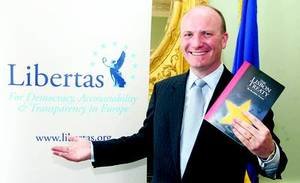
LIbertas on the war path... but to where?

The Sunday Telegraph today revealed plans by Declan Ganley, the man behind Libertas and the Irish No Vote to launch a Europe wide party to fight the Lisbon Treaty.

On first impressions, this should be an exciting prospect for Eurosceptics. With the demise of UKIP and the Tories saying one thing in the EU and another in Britain, eurosceptics have been left without a credible, electible party to vote for. Combine that with promises of "£75 million" and it starts to look promising.

However, there are many, many questions here. First of all, Ganley isn;t a real eurosceptic. He is just against the Lisbon Treaty. What's more, he wants his new party to represent this extremely narrow political position; "We will tell people that Libertas is the box you put your X in if you want to vote 'No' to the Lisbon Treaty. It's clear, it's simple".

But will people really vote for this? It's a no vote to the Lisbon Treaty, but what does that really achieve? EU officials are fond of telling us that the treaty is necessary because the EU isn't working in its enlarged state. Eurosceptics will tell us that the EU just isn't working. So what's the solution? Ganley doesn't appear to have an answer. This is hardly an inspiring platform from which to fight an election.

The next issue is that of money. Closer inspection reveals that he is hoping to "raise £75 million from online donations". Well I am hoping to raise that much too, but it doesn't mean that I am going to get it. If he was putting £75 million in himself, then fair enough, but this is just a number he has plucked out of the air. He's not going to stop at £75 million is he ever gets that high, and more than likely he will never reach it... so what is the point of the number, other than for PR purposes?

And how far will £75 million go anyway? With 400 candidates promised, that is £187500 per candidate. Assuming that he fills all 78 potential slots in Britain (and there is no reason not to once the £6k deposit per region has been paid) hat would roughly translate to £14.6 million spent in Britain on the election. That's a lot of cash, if he can raise it. To put it in perspective, at the last EU elections, the Tories spent £3,130,265.00, Labour spent 1,707,224.00 and UKIP's impressive result cost £2,361,754.00. so the answer to the question is... a very long way.

More analysis on the EU Referendum blog.